You’re pregnant, exhausted, or both, and you just typed “best infant car seat” into Google for the fourth time this week, only to close the tab again because every list disagrees with the last one. We get it. That’s the whole reason this site exists.
So we did the thing you don’t have time to do: we went through Consumer Reports’ crash-test data, NHTSA safety stats, CPST buying guides, and a genuinely unreasonable number of Reddit threads and Amazon reviews, and pulled out what actually matters — and what doesn’t.
Here’s the short version, then the long version for anyone who wants to know why.
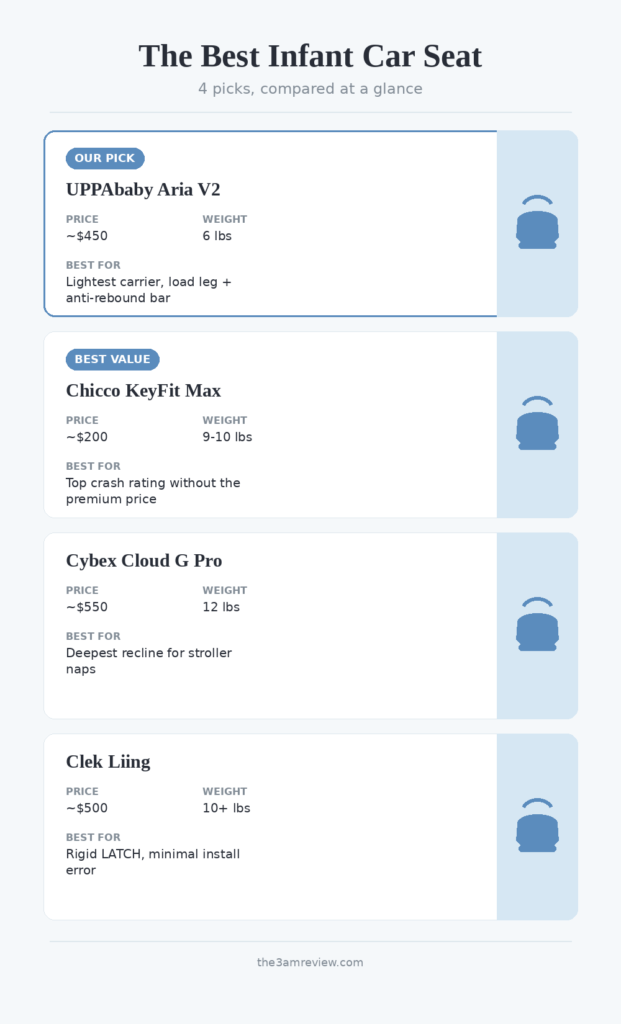
The Pick: UPPAbaby Aria V2
If you only read one paragraph of this post, read this one.
The Aria V2 is the lightest infant car seat carrier on the market at 6 lbs, which sounds like a small thing until you’re the one lifting a sleeping baby out of the car for the fifteenth time that day. Most infant seats in this category weigh closer to 9-10 lbs before you even add the baby. Despite the low weight, it still includes a load leg and anti-rebound bar — safety features usually reserved for heavier, bulkier seats, so you’re not trading protection for convenience.
It also has the two features that come up constantly in CPST buying guides: a no-rethread harness (so you’re not re-threading straps every growth spurt) and a red-to-green tension indicator, which takes the guesswork out of the single most commonly botched step in car seat installation — getting it tight enough.
Price: ~$450 | Best for: Parents who’ll be moving the seat in and out constantly and want one less thing to think about at 6am.
👉 Check current price on Amazon
Runner-Up: Chicco KeyFit Max
If the Aria V2 is out of budget, the KeyFit line has been the industry’s go-to recommendation for years for a reason — it’s consistently one of the highest crash-test performers in its price range, and it’s about as close to “foolproof to install” as infant seats get. It’s heavier than the Aria and doesn’t have the same premium features, but Consumer Reports has repeatedly noted that a higher price tag doesn’t necessarily mean better crash protection — it usually just buys nicer fabric.
Price: ~$200 | Best for: Parents who want CR’s top safety rating without the premium price.
👉 Check current price on Amazon
Also Worth Knowing About: Cybex Cloud G Pro & Clek Liing
Both come up again and again in expert buying guides for the same reasons: rigid LATCH systems that click in with minimal room for error, load legs for extra crash protection, and clear color-coded installation indicators. The Cloud G Pro delivers a notably deeper recline outside the vehicle than most competitors, which some parents love for stroller naps (safety experts still recommend limiting time in any car seat outside the car). The Clek Liing’s carrier runs heavier than most (10+ lbs), so if you’re petite or dealing with a bad back postpartum, that’s worth factoring in before you fall in love with it online.
👉 Cybex Cloud G Pro on Amazon | Clek Liing on Amazon
What Actually Matters When You’re Choosing (The Buying Guide Part)
Every car seat sold in the US has to pass the same federal safety standard. This is worth repeating because it’s easy to assume the $500 seat is inherently safer than the $150 one. It isn’t automatically. The standard is a floor, not a ranking — all seats have to clear it or they can’t be sold at all.
Rear-facing matters more than the calendar used to suggest. The old “one year, twenty pounds” rule is outdated. Rear-facing seats reduce fatal injury risk by 71% for infants and 54% for toddlers ages 1-2 compared to forward-facing, which is why the current guidance is to stay rear-facing as long as your seat’s height/weight limits allow — often well past a first birthday.
Installation quality matters more than seat quality. More than half of all car seats in the US are installed with some kind of error. The two features that most reliably prevent that: a tension indicator that visibly confirms a tight install, and rigid/push-on LATCH connectors that click into place with less room for user error than a seatbelt install.
“Premium” features are genuinely optional. Even Jamie Grayson, the most-followed Certified Passenger Safety Technician on TikTok, has pointed out that features like no-rethread harnesses aren’t must-haves for every family — they’re a convenience upgrade, not a safety requirement. Don’t let a features checklist talk you into overspending if a simpler seat fits your budget and your car.
A seat only protects your baby if it’s installed correctly. If you take away nothing else from this post: however you narrow down your choice, get the final install checked by a free local car-seat safety check event or a certified CPST before your baby’s first ride. Most fire departments and hospitals offer this for free.
We’re parents and researchers, not car seat engineers — everything here comes from aggregating expert sources (Consumer Reports, NHTSA, CPSTs), not our own testing. Always double-check fit and installation for your specific car and kid.
We aggregate reviews from Consumer Reports, NHTSA data, CPST buying guides, and real parent experiences on Reddit and Amazon so you don’t have to. Got a car seat question we didn’t cover? Let us know.
As an Amazon Associate, The 3AM Review earns from qualifying purchases.